How to Measure AI ROI in a Small Business (With a Worked Example)
The short answer
AI return on investment is the value of the time and errors it saves minus everything it costs. Monthly net value = hours saved × loaded hourly cost − review time × loaded hourly cost − tool subscriptions − setup time spread over a few months. Measure hours against a baseline you timed before the pilot, and only count saved time that was used for other work.
“It saves us time” is not a business case. To decide whether an AI tool is worth keeping, expanding or cancelling, you need a number. The good news is that the math is simple; the hard part is being honest about the inputs.
The formula
Monthly net value = (hours saved × loaded hourly cost) − (review hours × loaded hourly cost) − tool costs − setup costs spread over 6 to 12 months.
The loaded hourly cost is what an hour of someone’s time really costs the business: wage plus payroll taxes, benefits and overhead. A common shortcut is base hourly wage × 1.25 to 1.4.
A worked example
A four-person team piloted an AI assistant on three tasks for a month. They timed each task the old way first, then logged time during the pilot, including the time spent checking and fixing outputs.
AI PILOT, ONE MONTH
Customer emails: 30 h × 40% saved12.0 h
Weekly reports: 12 h × 60% saved7.2 h
Email drafting: 20 h × 50% saved10.0 h
Hours saved29.2 h
× loaded cost $35 an hour$1,022
Review time: 6 h × $35−$210
Four seats at $30−$120
Setup: 10 h × $35 over 6 months−$58
Net value per month+$634
Every input is an assumption. Swap in your own.
Laid out as a waterfall, you can see where the gross value goes.
A net value of $634 a month on $120 of subscriptions is a strong result. Just as important, the log showed which task delivered most: reports, with a 60% saving and little review. That is where to expand next.
How to measure time saved honestly
- Time the baseline first. Do each task the old way at least three times before the pilot and take the average.
- Include review and fixes. A draft that takes 2 minutes to generate and 15 to correct saved less than it looks.
- Log for a full month. The first week is slower while people learn; the last week is closer to reality.
- Ask where the hours went. Saved time only has value if it went to sales, service or work that was being postponed.
Value that is not time
Some benefits are real but harder to price. Count them separately rather than inflating the hours:
- Speed to customer: quotes sent the same day instead of next week can win deals.
- Fewer errors: consistent checklists and calculations reduce rework and refunds.
- Capacity: handling growth without a new hire is worth the cost of the hire you avoided.
Mistakes that inflate AI ROI
- Counting the time to generate a draft and ignoring the time to fix it.
- Using best-case examples instead of a month of real logs.
- Counting saved hours that turned into idle time.
- Forgetting setup: writing briefs, training staff and connecting tools.
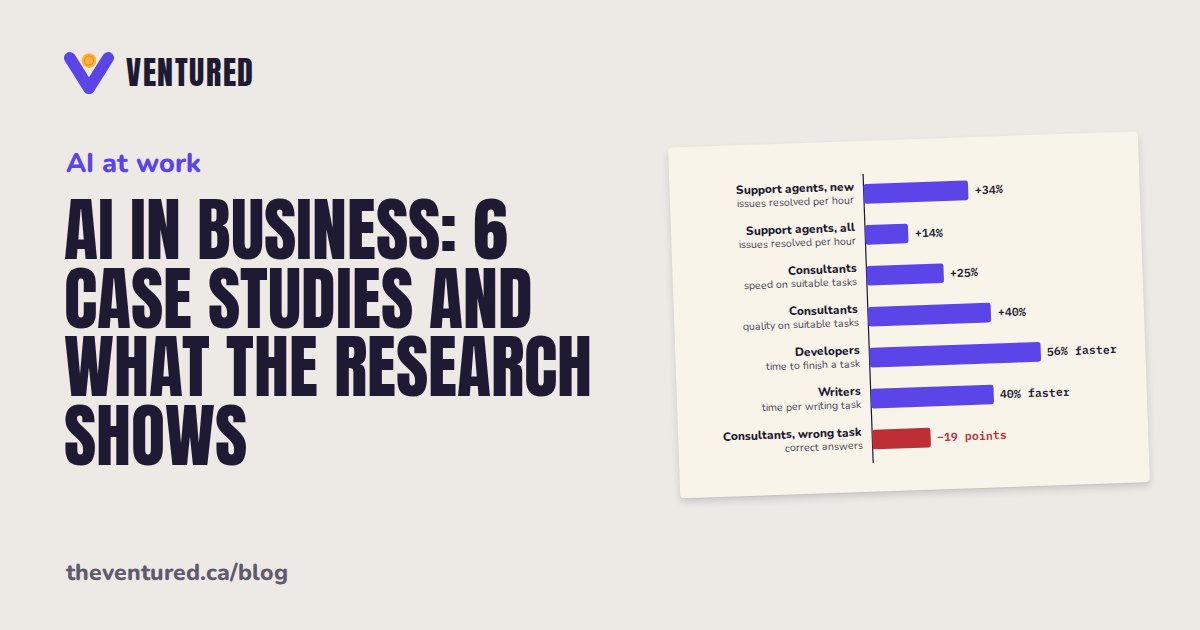
Measured results from larger companies, including where AI made things worse, are in our AI case studies.
Bottom line
Measure AI like any other investment: time a baseline, log a real month, subtract review time, tools and setup, and only count hours that went somewhere useful. If the net value is clearly positive, expand to the next task; if it is not, change the task before you change the tool.
Common questions
What is a good ROI for AI tools?
If the monthly net value is several times the subscription cost and the review burden is falling, the tool is earning its place. In the worked example, $634 of net value on $120 of tools is about five times the cost.
How do I measure time saved by AI?
Time each task the old way at least three times to get a baseline, then log time during the pilot including review and fixes. The difference, averaged over a month, is the time saved.
Should I count time saved if nobody was hired or let go?
Yes, if the time went to useful work such as sales, service or postponed projects. If it did not go anywhere, it is not value yet.