Investing Basics: Compounding, Diversification and Fees, Explained With Charts
The short answer
Long-term investing rests on three ideas: compounding, which needs time; diversification, which spreads risk across many companies; and low costs, because fees compound too. Investing $300 a month for 30 years at a 6.9% return after fees grows to about $358,851; the same plan at 6.0% after a 1% fee ends near $301,355. Build an emergency fund and clear high-interest debt first.
This article is general education, not financial advice. Your situation, taxes and the accounts available to you depend on where you live; consider speaking with a licensed advisor before making decisions.
Investing advice is often either too vague (“start early!”) or too complicated. This guide covers the few ideas that do most of the work, with the math shown so you can check it.
First, the order of operations
- Build an emergency fund. A common rule of thumb is three to six months of essential expenses in a savings account, so a surprise bill does not force you to sell investments at a bad time.
- Pay off high-interest debt. Paying off a credit card charging 20% is a guaranteed 20% return. No ordinary investment reliably beats that.
- Use tax-advantaged accounts available where you live. In Canada that means accounts such as the TFSA and RRSP; in the US, a 401(k) or IRA; in the UK, an ISA. Rules and limits change, so check the official sources.
Compounding needs time
Compounding means your returns start earning returns. At a 7% yearly return, $300 a month for 30 years grows to about $365,991, while your own deposits total $108,000. Most of the final balance comes from growth, and most of that growth happens in the later years, which is why time in the market matters more than finding the perfect moment.
A quick mental shortcut is the rule of 72: divide 72 by the yearly return to estimate how many years it takes money to double. At 7%, that is about 10 years.
Fees compound too
A 1% fee sounds small. Over decades it is not, because it is taken from the whole balance every year, including past growth.
In this example, the investor paying 1% ends up with about $57,497 less than the one paying 0.1%, on exactly the same deposits. When comparing funds, look for the management expense ratio (MER) or expense ratio, and any advisory or account fees on top.
Diversification
A single company can fail; a whole market rarely does. Diversification means owning many investments so one bad result cannot sink you. Broad index funds and ETFs hold hundreds or thousands of companies in one purchase, usually at low cost. S&P Dow Jones Indices’ long-running SPIVA reports have found for years that most actively managed funds trail their benchmark index over 10 to 15 years, which is a big reason low-cost index investing is popular.
Risk and time horizon
Stock markets can fall 30% or more in a year and take years to recover. A common rule of thumb is not to put money you will need within about five years into stocks. Many investors hold a mix of stocks and bonds, with more bonds as the money is needed sooner. The right mix depends on your goals and how you would feel watching your balance drop.
Habits that matter more than picks
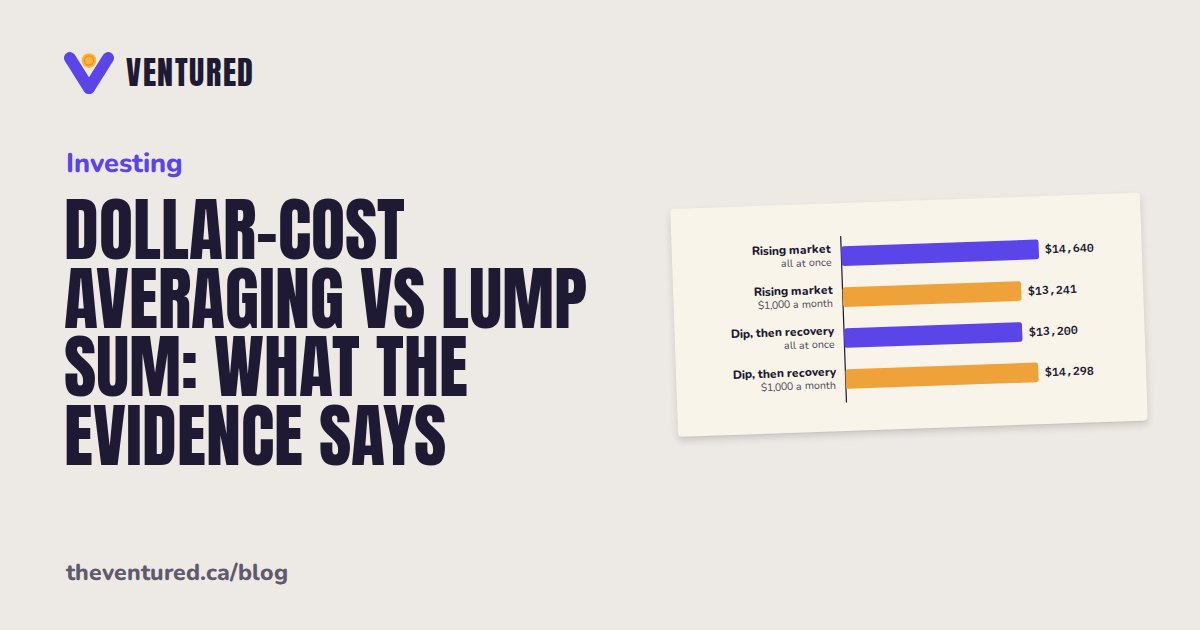
- Automate a monthly contribution so investing happens before spending. Investing every paycheck is a form of dollar-cost averaging.
- Rebalance once a year back to your chosen mix.
- Do not react to headlines. Selling after a fall locks in the loss.
- Keep costs low and know every fee you pay.
Business owners face the same trade-offs inside their companies; see how investors value a business in investment valuation basics.
Bottom line
Emergency fund first, high-interest debt next, then regular contributions to diversified, low-cost investments in the tax-advantaged accounts available to you. Give compounding decades, keep fees low, and do not let a bad year change a long-term plan.
Common questions
How much should a beginner invest each month?
An amount you can keep investing through bad months, after an emergency fund and high-interest debt repayment. Consistency matters more than the starting amount; you can raise it as income grows.
Are index funds safe?
They are diversified, which removes the risk of any single company failing, but their value still rises and falls with the market and can drop sharply in a downturn. They suit money you will not need for several years.
What is the rule of 72?
A shortcut for doubling time: divide 72 by the yearly return. At 6% money doubles in about 12 years; at 8%, in about 9.